Heat Input Master
Calculate welding heat input for a pass, evaluate it against an acceptance profile, keep an immutable verification log, and export XLSX, CSV, JSON, and PDF reports — without uploading any project data.
What it does
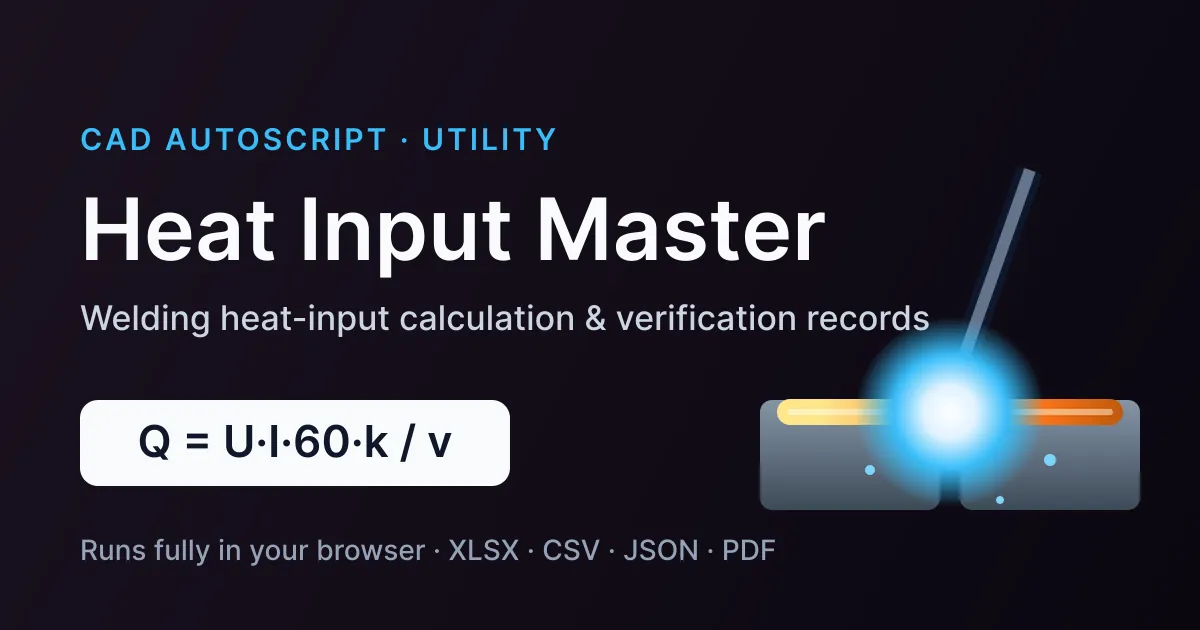
Heat Input Master is a client-side engineering aid for welding heat-input calculation and verification recording. Select the welding process, enter current, voltage, and travel speed (or weld length and time), choose an efficiency (k-factor), and the utility computes arc heat input Q = U·I·60·k / (v·1000) in kJ/mm, showing both gross and effective power and the full equation. Each pass can then be evaluated against an acceptance profile and stored as an immutable verification-log entry.
The app is built as a standalone micro-application under static/utility-apps/heat-input-master. The CAD AutoScript shell embeds it in an iframe, so the calculator can evolve independently while sharing the same catalog, article, reactions, comments, and access layer as the other utilities.
When to use it
- Calculating heat input for a welding procedure qualification (WPS/WPQR support).
- Recording measured current, voltage, and travel speed for production weld verification.
- Comparing single, min/max midpoint, and three-sample (Method A/B) measurement sets.
- Checking whether a pass falls inside an approved heat-input acceptance window.
- Producing an XLSX log or a PDF verification report for QA review.
Inputs and outputs
| Area | Inputs | Outputs |
|---|---|---|
| Process | ISO 4063 process, current type/polarity | Provenance on each pass; process-appropriate defaults |
| Electrical | Current, voltage, efficiency (k-factor) | Gross and effective arc power |
| Speed | Travel speed, or weld length + time | Travel speed, heat input (kJ/mm) |
| Measurement | Single, min/max midpoint, three-sample | Aggregated result with basis disclosure |
| Acceptance | Acceptance profile (approved or draft) | Pass / warn / not-evaluated status |
| Records | Project, pass metadata, revision | Verification log, XLSX / CSV / JSON / PDF exports |
Important limits
The bundled efficiency and acceptance profiles are marked as unapproved example datasets. They make the workflow testable, but they are not a certified engineering basis. Pulsed and AC selections are recorded as provenance and deliberately do not alter the heat-input value (no unapproved coefficient), and they raise an accuracy warning because average U·I may not equal true arc energy. Before using results for a real weld, replace the profiles with the governing procedure or standard and have the calculation verified by a qualified welding engineer.
Workflow
- Select the welding process and enter the electrical and speed measurements.
- Choose the measurement mode (single, min/max, or three-sample).
- Review the live heat-input result, gross vs. effective power, and the disclosed equation.
- Assign an acceptance profile to evaluate the pass (or leave it not-evaluated).
- Save the pass into the verification log; edit or fine-tune rows in place as needed.
- Export the log as XLSX, CSV, or JSON, or generate a multi-page PDF verification report.
Assumptions & standards
- Standards basis: Process identification follows ISO 4063; efficiency (k-factor) usage and the pulsed/AC accuracy caveats are oriented on EN 1011 and ISO/TR 18491, using bundled example datasets rather than certified tables.
- Key assumptions:
- Heat input is computed as
Q = U·I·60·k / (v·1000)in kJ/mm from the entered values. - The efficiency factor is applied as entered; polarity and pulsing are recorded but do not change Q.
- Measurement aggregation uses the values exactly as entered for the selected mode.
- Heat input is computed as
- Limitations:
- The bundled efficiency and acceptance profiles are example-only development datasets, not a certified engineering basis.
- t8/5, CEV/CET/Pcm, and preheat models are out of scope in this MVP.
- The optional weld-geometry preview is an illustrative heuristic, not a validated model, and is excluded from every export.
- ⚠️ Heat Input Master provides decision-support calculations. It is not an automatic WPS/WPQR approval or certification authority; results must be verified by a qualified engineer against the governing code edition and the project specification.
Related tools
Feedback / bug report
- Open a GitHub issue
- Email or DM with the slug
heat-input-masterso we can reproduce the issue.